

Healthcare leaders often discuss the registered nurse shortage as a national workforce issue. Yet behind every national projection are communities, hospitals, and patients whose access to care will be shaped by what happens in their specific state. The gap between projected supply and demand varies significantly, and for hospital leaders, understanding where those gaps are deepest is where workforce planning must begin.
According to the latest HRSA Health Workforce Projections, the United States is projected to face a shortage of 108,960 registered nurses by 2038.1 More seriously, several states are expected to operate well below the nursing workforce needed to meet patient demand.
The shortage will not affect every state equally. For hospital leaders, the question is not whether gaps are coming, but how to prepare for them before they arrive.
Understanding What the State-Level Data Means
Looking only at vacancy numbers can underestimate workforce risk. The HRSA projections introduce another measure that deserves greater attention: percent adequacy. This reflects how much of a state's projected nursing demand can realistically be met by its available workforce.
The data below shows projected registered nurse supply, demand, and shortage for the 10 states facing the most acute gaps through 2038, based on HRSA Health Workforce Projections.
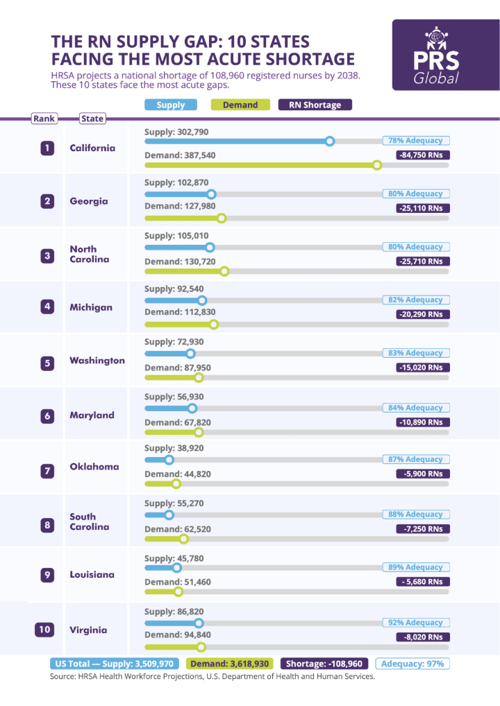
For hospital executives, percent adequacy offers a stronger foundation for workforce planning because it measures the long-term balance between supply and demand rather than today's hiring activity.
1. Percent adequacy tells a more complete story than shortage numbers.
California is projected to experience the nation's largest shortage, with 84,750 fewer registered nurses than needed by 2038. More revealing is its projected 78 percent adequacy, meaning the state's nursing workforce would meet only about three-quarters of expected demand.
The pattern extends beyond California. Georgia and North Carolina are each projected to operate at 80 percent adequacy, while Michigan and Washington remain below 85 percent. Even Virginia is expected to reach only 92 percent adequacy.1
These figures suggest that many healthcare organizations will be recruiting within labor markets that remain structurally constrained, even if individual vacancy rates fluctuate over time.
2. Workforce shortages are becoming structural.
Some shortages reflect population growth. Others stem from an aging workforce, retirements, and continued demand for experienced clinicians.
Recent findings from the National Council of State Boards of Nursing reinforce this challenge. More than 138,000 nurses left the workforce between 2022 and 2024, and nearly 40 percent of registered nurses report plans to leave the profession or retire within the next five years, underscoring why workforce recovery remains uncertain despite improvements since the pandemic.2
This means that more than the expected annual turnover, hospitals are preparing for long-term changes in workforce availability.
3. The experience gap remains just as important as the staffing gap.
Expanding nursing education is important, but more graduates do not immediately create experienced nursing teams.
Newly licensed nurses require structured onboarding, mentorship, and preceptor support before practicing independently in complex care environments. As a result, organizations are balancing two priorities simultaneously: strengthening the future pipeline while maintaining sufficient experience at the bedside today.
Read more: Why the Experience Gap Is Still a Leadership Priority
Practical Workforce Planning Considerations
Hospitals cannot change statewide workforce projections, but they can adjust how they prepare for them.
1. Incorporate state projections into workforce planning.
Review projected adequacy alongside retirement forecasts, turnover trends, service-line expansion, and anticipated patient demand. Understanding how external labor market conditions intersect with internal workforce data creates a more realistic planning horizon.
2. Build recruitment strategies around long-term capacity.
When shortages are expected to persist through 2038, annual hiring plans alone may not provide enough stability. Multi-year workforce planning allows organizations to diversify recruitment sources before shortages become more difficult to address.
3. Consider international direct hire as part of a balanced workforce strategy.
International direct hire is not a replacement for domestic recruitment. It is one structural response to an evolving labor market where experienced nurses remain in limited supply.
For many organizations, internationally educated nurses help strengthen core staffing, support continuity of care, and provide greater workforce stability while domestic recruitment and professional development efforts continue. When integrated into broader workforce planning, international direct hire complements the domestic nursing pipeline rather than competing with it.
Look Beyond the Numbers.
The HRSA projections make one point especially clear: the nursing shortage will not affect every state equally. Percent adequacy provides healthcare leaders with a more meaningful way to understand workforce risk because it reflects whether projected supply can realistically support future patient demand.
Organizations that begin planning around these long-term trends today will be better positioned to maintain clinical capacity, strengthen experienced nursing teams, and support sustainable workforce growth over the coming decade.
If your organization is evaluating how projected nursing shortages could influence your long-term workforce strategy, contact PRS Global today. Together, we can explore how international direct hire fits within a broader workforce planning approach.
References
- "Health Workforce Projections.” HRSA, 13 Jul. 2026, https://data.hrsa.gov/topics/health-workforce/nchwa/workforce-projections
- “NCSBN Research Highlights Small Steps Toward Nursing Workforce Recovery; Burnout and Staffing Challenges Persist.” NCSBN, 17 Apr. 2025, https://www.ncsbn.org/news/ncsbn-research-highlights-small-steps-toward-nursing-workforce-recovery-burnout-and-staffing-challenges-persist